


XRP price experienced one of the steepest declines this year. It fell from $2.83 to $1.77 in a few hours, before rebounding to around $2.44.
Even after that rebound, the token is still down about 14% in 24 hours and nearly 20% for the week. But the data shows this is no ordinary decline. It was a panic-driven, derivative-driven flush, not an actual token sell-off. And now, as an XRP price rebound is forming, major groups are seen adding to their token stash.
Sponsored Sponsored
Panic-driven derivatives crash, not spot selling
On-chain data confirms that this is not a wave of investors dumping their tokens.
Over the past month, the supply of XRP on exchanges has barely moved despite this steep drop, indicating that very few coins were sent to exchanges for sale.
Rather, the decline may have started in the derivatives market, where overleveraged long positions were liquidated as prices broke through key support levels. If this happens, the exchange will automatically close the futures contract and cause a forced sale on the order book, even if the tokens do not move on-chain.
Want more token insights like this? Sign up for Editor Harsh Notariya’s Daily Crypto Newsletter here.
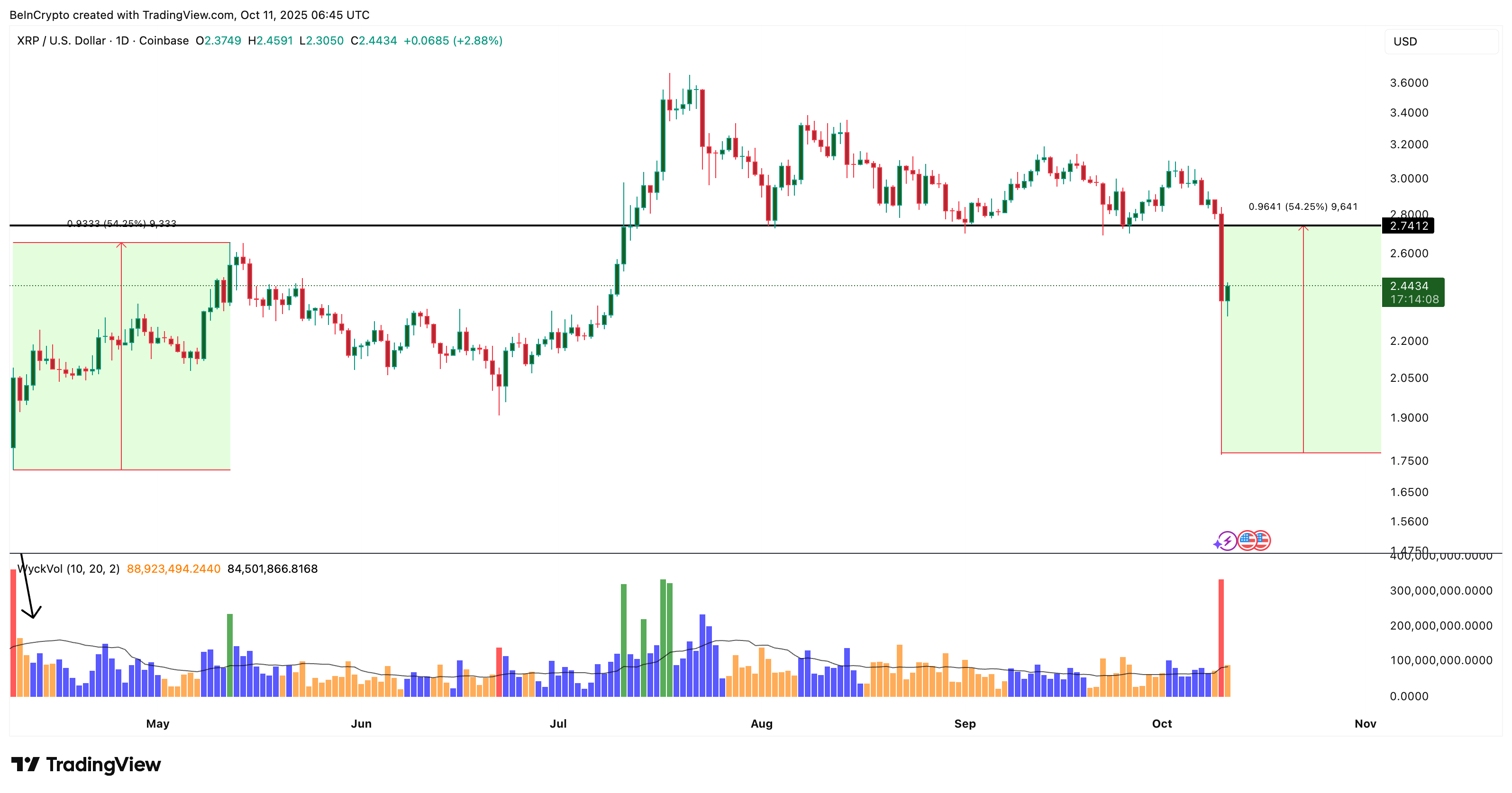
This off-chain panic is clearly visible in the Wyckoff Volume Spread Analysis (VSA). A huge red bar forms at the peak of the liquidation wave, followed by a yellow bar as the sell-off eases.
Sponsored Sponsored
A transition from red (full sales control) to yellow (lesser control) usually means liquidations are subsided.
Wyckoff Volume Spread Analysis (VSA) tracks how price and volume interact and indicates when buying or selling pressure prevails. VSA doesn’t know where that volume comes from. It does not differentiate between spot sales and derivative-driven liquidations.
The last time XRP’s Wyckoff bar showed a similar red-to-yellow change in early May, the token rebounded more than 54% from its lows. If this pattern repeats, similar moves may continue after the panic fades. This puts the XRP price target of $2.74 in place.
Whales increase as market cools
While small traders were being weeded out, whales were quietly buying.
Sponsored Sponsored
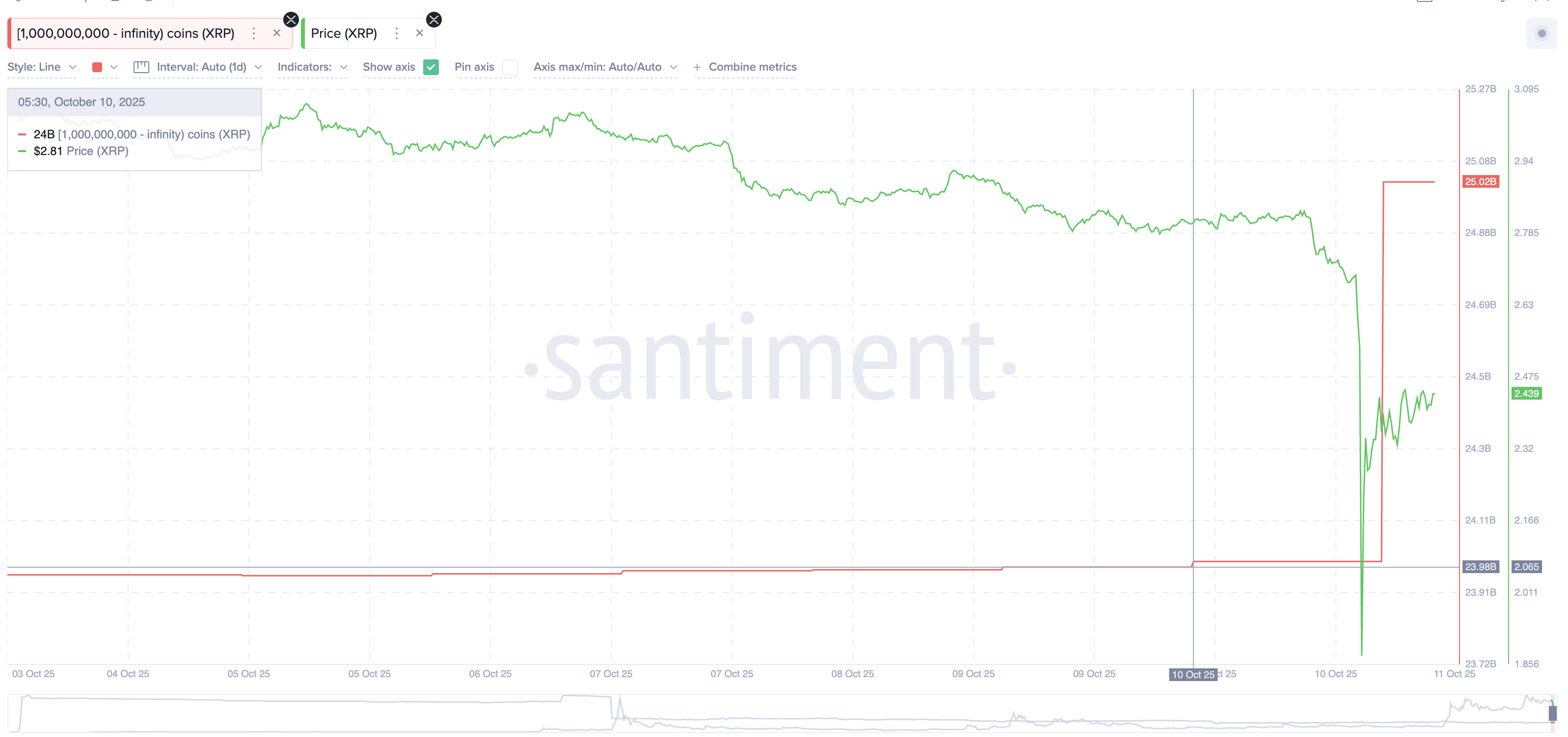
According to Santiment data, the holdings of wallets holding more than 1 billion XRP increased from 23.98 billion to 25.02 billion after the crash. This is approximately an additional 1.04 billion XRP, equivalent to approximately $2.54 billion at current XRP prices.
Its behavior is consistent with the on-chain situation. The lack of a large spike in exchange balances and the increase in whale holdings means this was a derivatives panic caused by whale accumulation, rather than a physical sell-off.
Note: A stable replacement supply also fits the image. Large holders typically purchase through over-the-counter transactions or internal swaps. Therefore, their accumulation will not immediately appear as an outflow of on-chain exchanges.
Such setups often mark the trough of a sentiment-driven crash, with stronger stocks absorbing weaker stocks before a recovery begins.
Sponsored Sponsored
As recovery progresses, XRP price focuses on “this rebound target”
At the time of writing, XRP is trading at $2.44. This level coincides with the 0.5 Fibonacci level from the previous swing high to the $1.70 zone, a multi-week low.
If XRP manages a daily close above $2.43, the structure will strengthen towards $2.59. This could be followed by $2.82 (a major resistance level). This is in line with Wyckoff’s prediction of a break above $2.74 shown on a previous chart.
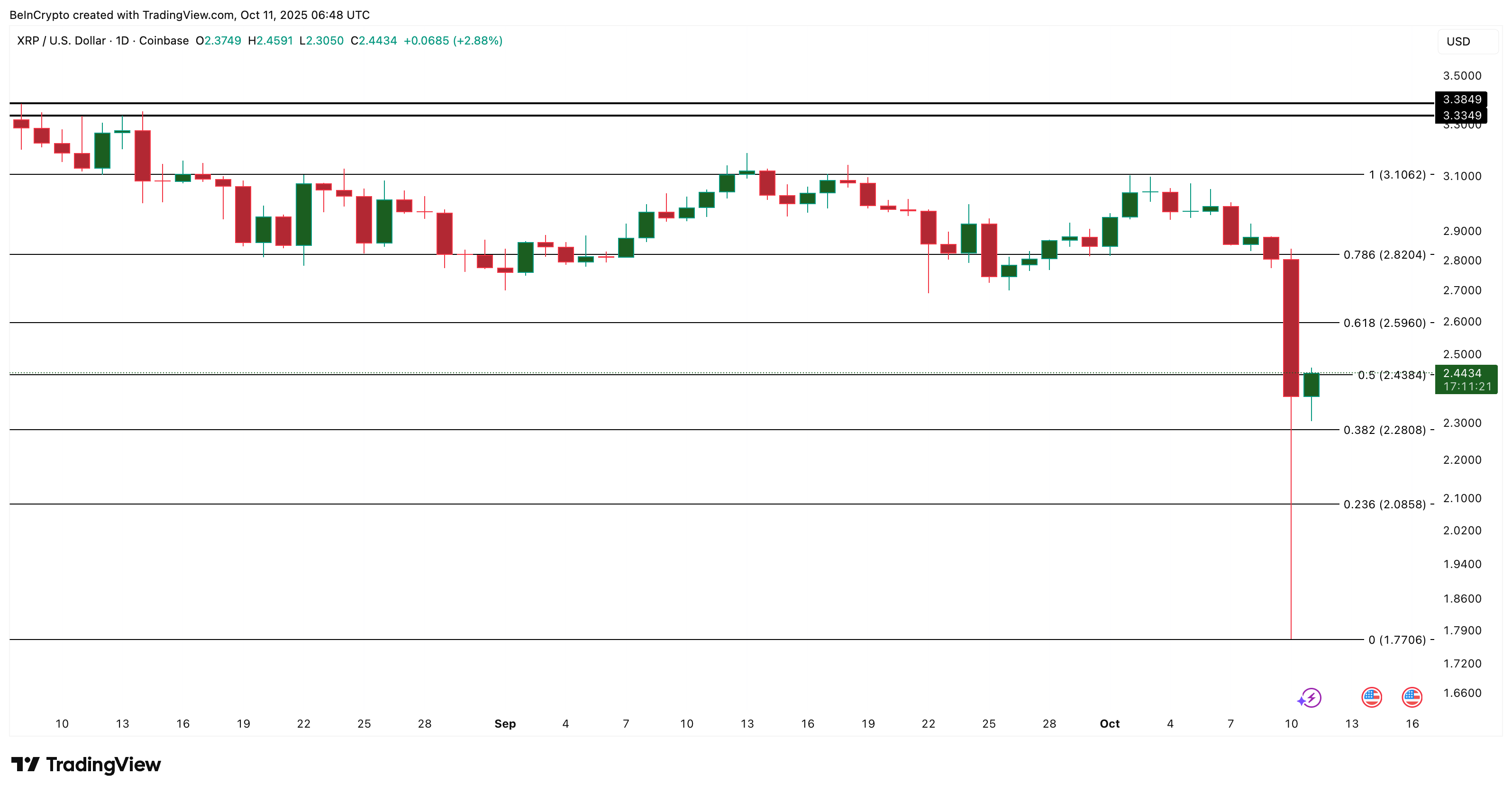
However, if the XRP price falls below $2.28, the setup could weaken and the downside risk could extend to $2.05.
Data shows a clear shift in sentiment as whales increase, currency supply stabilizes and panic liquidations ease. This was not a true capitulation, but rather a sentiment-driven washout that could set the stage for XRP’s next short-term rally.
