

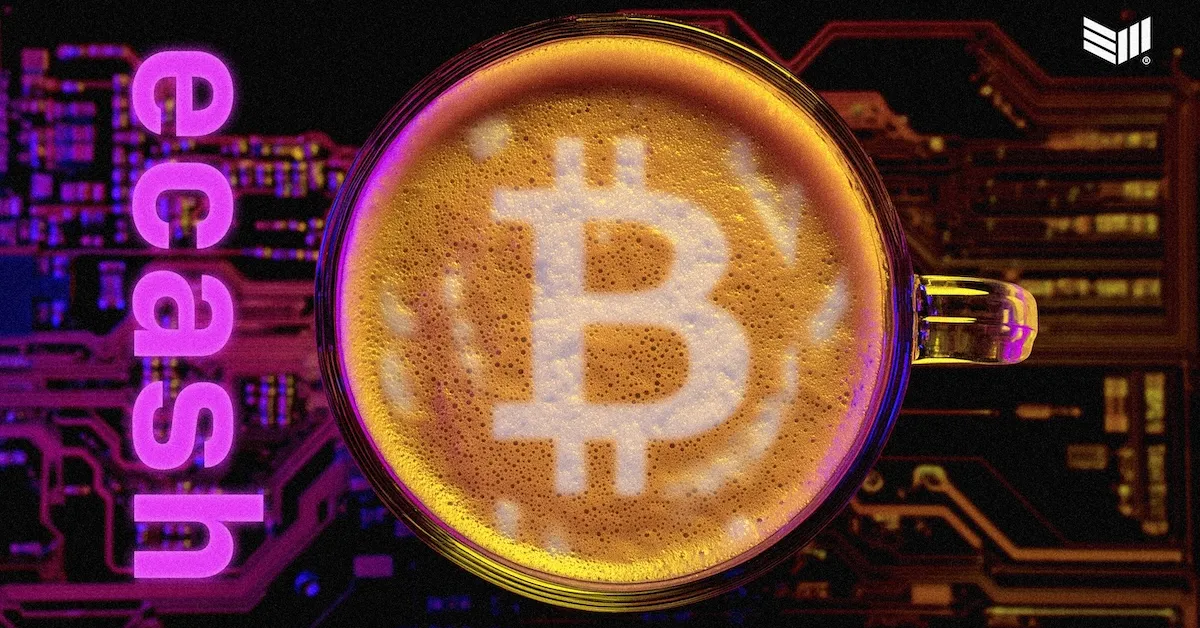
Four years ago, in a building in the heart of Prague’s former industrial center, Eric Silion sat on a computer with newly written code and a simple mission. I bought some coffee with Bitcoin.
This place was Parallelnipolis during the annual hacker conference. This is a fitting place for the experiment of digital freedom. This wasn’t the first time Bitcoin has been used to buy coffee, but this time it was different. After some false start, the transaction finally passed and history took place. This was the world’s first purchase using Ecash with Bitcoin. Specifically, it is the Fedimint Ecash Protocol, a Chaumian Ecash system built on top of Bitcoin.
Eric marked the moment in a tweet, and what seemed like a small act — just coffee — became much bigger.
Sparks were illuminated.
Privacy Heritage
To understand the importance of that coffee, we must look back even further.
In the 1980s, David Chaum introduced the concept of Ecash, a pioneering digital money that was private by default through encryption innovation. His company, Digicash, was ahead of its time, but he endured the core ideas.
A few years later, Hal Finney, Nakamoto Atoshi’s first Bitcoin transaction recipient, was recognized not only for the potential of Bitcoin, but also for its limitations. He foresees the need for layers above Bitcoin, which can provide stronger privacy protections, and reflects Chaum’s vision based on Bitcoin’s resilience.
When Eric Silion bought that coffee in Prague, he was building on this lineage – carrying Chaum’s ideas and Finny’s foresight into a practical protocol for private payments on Bitcoin.
From a cup of coffee to the movement
In the next few months, the Fedimint protocol was released, accelerated development and adopted began to widen. Shortly afterwards, another protocol, Cashu, came into the scene, offering a single mint model that provided setup and rapid experimentation. In contrast, FEDIMINT enabled resilience through multi-party federation custody. Together, these approaches added fuel to what has become a vibrant and growing Ecash ecosystem.
Since then, more and more projects aiming to expand Bitcoin have begun exploring or implementing enhanced privacy, in addition to the most difficult money the world has ever seen. There is growing awareness that this will leave the most vulnerable exposure by scaling Bitcoin without privacy.
The new scaling solution, BITVM, has influenced the concept of ZK coins. This is an Ecash-like system that is still under development but reduces the assumption of promising trust.
ARK – Layer 2, which offers a way to scale lightning transactions in the most reliable way, is still early, but it is investigating privacy as one of its potential core features.
Spark – The system that uses state chains to increase Bitcoin’s transaction throughput has gained traction recently and is already committed to adding privacy features as it evolves.
On-chain innovations such as Wabisabi, Coinswap and Silent Payments are also underway. It makes it difficult to track transactions and reduce address linkability without introducing a new trust model.
What we’re seeing is not a single move led by either protocol, but a certain awareness is rising across the Bitcoin ecosystem. Privacy is not an option. Ecash was the pioneer of this conversation, with its vision and practical use cases. That advancement may help influence or accelerate broader interests, but ultimately, it is integrating multiple projects and integrating on-chain and off, with the shared goal of protecting Bitcoin’s financial privacy.
“Without privacy, Bitcoin is at risk of becoming vulnerable to coercion and abuse. Privacy makes it a lifeline.”
Why Privacy is more important than ever
This is more than just a technical discussion. The stakes are real.
Around the world, Ecash is already being used by some of the most impossible communities. People living under authoritarian regimes, activists, journalists and families working under constant surveillance are simply trying to trade safely without being surveillance or censored.
As authoritarianism rises globally, the need for private tools is becoming stronger. Without privacy, Bitcoin risks becoming vulnerable to coercion, surveillance and abuse. Due to privacy, Bitcoin becomes a lifeline. We provide empowerment for everyone, especially those who need it most.
Ecash Coffee Day: From celebrations to meetings
Last year, we began celebrating Ecash Coffee Day at Fedy as a carefree way to celebrate the 3rd anniversary of our first Ecash Coffee purchase in Bitcoin. But today it has a deeper meaning.
Ecash Coffee Day should not only serve as a commemoration of where we came from, but also serve as a call to action. Anchor dates reminding me of unfinished work. Until Bitcoin has privacy by default, for everyone, anywhere, our work is not finished.
This day should remind you that privacy is not an add-on, not a luxury, not just a feature request. It is an unnegotiable cornerstone of freedom. And even if you achieve strong privacy with Bitcoin, Ecash Coffee Day will survive.

So let’s mark this anniversary with a commitment, not just a celebration.
A commitment to building, funding and supporting privacy-providing technologies.
A commitment to confirming not only experiments but mass adoption over the next four years.
A commitment to the principle that the ability to personally trade is a fundamental human right.
Ultimately, it’s not just codes, protocols, or even Bitcoin itself. It is about people and their ability to live, flourish and become free.
One Bitcoin Harving – that coffee lesson in Prague was not clear. Privateness is important.
In other words, transaction privacy – ideally, individually run is essential for Bitcoin to be truly successful.
Source: https://bitcoinmagazine.com/technical/why-ecash-coffee-day-is-no-longer-just-a-celebration-but-a-call-to-action
