

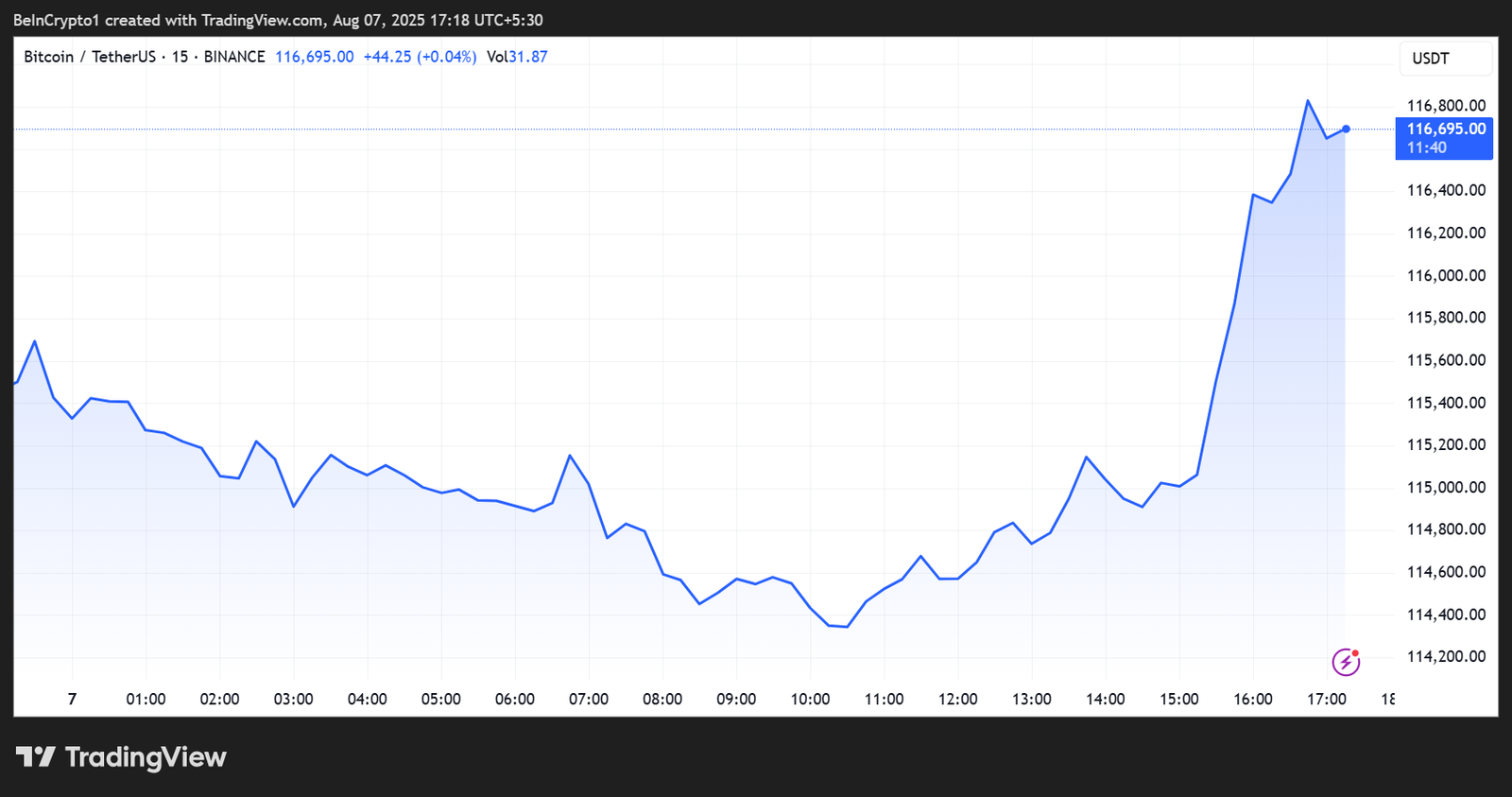
Bitcoin (BTC) has recovered a psychological level of $116,000, approaching its peak in July.
The recovery follows reports that US President Donald Trump is preparing to sign a drastic executive order that allows crypto and other alternative assets to enter a 401(k) retirement account.
Trump’s impending executive order pushes Bitcoin up nearly $117,000
At the time of writing, Bitcoin was trading at $116,695. This climbed significantly after opening Thursday’s trading session in the $114,000 range.
The surge follows a report from an imminent executive order directing the Department of Labor to reevaluate guidance under the 1974 Employee Retirement Income Security Act (ERISA).
In particular, this guidance traditionally excluded alternative assets such as crypto, real estate, and private equity from most worker retirement plans.
Bloomberg reports that the order directs the Secretary of Labor to coordinate with the Treasury Department, the US SEC (Securities and Exchange Commission), and other regulatory authorities.
Among other reasons, the goal is to ease the legal hurdles to being encrypted into defined inconsistent accounts.
“Sorry bullish for the cryptography!” said Crypto analyst Lark Davis in X.
Davis’ remarks highlight the market’s response to what could be a groundbreaking change in US retirement investment policy. With nearly $12.5 trillion held in a 401(k) account, the potential inflows into Bitcoin and other digital assets are massive.
Institutional investors such as pensions and donations have long been tapped into private equity and alternative markets. But the average American savings remained excluded until now.
The move reflects Trump’s broader pro-crypto agenda for 2025. Future orders are expectedabolitionBiden era code warning for the 401(k)s.
Nonetheless, allowing cryptography to your retirement account is not without challenges. Legal experts warn that 401(k) Planning Managers may face litigation related to volatility and high crypto or other illiquid assets costs.
Difficulties in assessment, custody risks, limited understanding of participants, and continuous changes in regulatory oversight remain concerns. Based on this, the fiduciary responsibility remains a core issue.
“In this early stage in the history of cryptocurrency, the department has serious concerns about the discretion of the fiduciary decision to publish participants in the 401(k) plan to invest in cryptocurrency or other products whose value is related to cryptocurrency,” the department said.
Bitcoin’s role is expanding in US finance
Still, supporters argue that the modern financial system has evolved. The public market has shrunk considerably since the 1990s, but private equity has more than doubled in the decade of 2023.
As financial innovation accelerates, Trump’s orders could unlock new diversification options for everyday investors. For crypto, the move could inject fresh liquidity into the market, and this optimism has already fueled the recovery of Bitcoin.
Beyond 401(k) access, Bitcoin is making quiet but significant progress on another cornerstone of the housing market, which is the US finances.
Beincrypto has reported on a pilot initiative to provide Bitcoin-backed mortgages through the new American Housing Credit Facility.
This approach allows Crypto Holders to access mortgages using BTC as collateral, potentially bridging decentralized finance (DEFI) in traditional credit markets.
But it’s not a clean sweep. Bitcoin mortgage recognition comes with regulatory strings, including strict loan-value ratios, collateral liquidity checks, and enhanced risk disclosure.
US regulators are also wary of the volatility and counterparty risks in encrypted household lending, even for innovative, encrypted innovations.
Post-Bitcoin has approached $117,000 ahead of Trump’s plan to open the 401(k)s into encryption.
