


The Federal Reserve’s 25-Basic Point (BP) rate cut was the first of 2025 and set the stage for a few weeks of market debate.
The move was widely anticipated, but at yesterday’s press conference, Chairman Jerome Powell’s Devish Tone and the Fed’s sharply divided dot plot made investors wonder what would happen next.
Powell shows risk management pivot
Powell framed rate reductions as a risk management decision in his opening remarks, citing an increase in cracks in the US labor market.
The revised payroll count shows that, along with a rise in long-term unemployment rates, 911,000 jobs are fewer than previously reported.
Sponsored Sponsors
“The risks to inflation are leaning upside down, and employment risks are leaning towards drawbacks,” Powell said.
The Fed chair also said policymakers must act preemptively to prevent a deeper recession.
Powell downplayed the impact of Trump’s tariff inflation and insisted that the pass-through was “slower and smaller” than expected.
However, he acknowledged that price pressure could last until 2026. At the same time, he explained that the labor market is no longer “solid.”
He cited slowing employment, immigration changed the decline in supply, and AI recruitment weighed heavily on entry-level jobs.
Conclusion: Powell’s comments were far more incredible than the 2024 guidance when the Fed increased by 50 bps. This suggests a deliberate pivot towards prioritizing employment against inflation.
Market reaction with Fed divisions on full display: dollar slides, liquidity of stocks
The new dot plot revealed by a central bank struggling to find consensus. Nine of the 19 staff members have seen two more cuts this year, while six are not hoping for any further easing.
One member projected the hike, with Trump’s appointee Stephen Milan opposed in favor of the 50 bps cut.
“This meeting was a mess…one member is thinking of hiking the Fed this year… another member thinks we’ll get five cuts. This rigging to create such an illusion and expose such a wide dot plot will only further undermine their credibility.
Sponsored Sponsors
Meanwhile, Kobeissi’s letter, called The Move Historic, has emphasized the first cut with core PCE inflation rates above 2.9% for over 30 years.
“It’s clear that the Fed prioritizes the labour market over inflation,” Kobeissi wrote, saying the market is hoping for four more cuts by September 2026.
The immediate market response was quick. The US dollar has fallen to its weakest level since February 2022, but stocks were close to record highs.
The futures market is on sale with at least two additional cuts by the end of the year, with Kalshi’s data showing the probability that three cuts are above 60%.
What did the market interpret from Powell’s speech yesterday?
BarChart highlighted that when the Fed cuts to a history-high 2% on the stock market, the S&P 500 historically boosted 100% of its time over 12 months, earning an average of 14% profit.
Fidelity’s Jurrien Timmer compared the moment to the LTCM crisis of late 1998.
Sponsored Sponsors
The crypto market is also closely watching the liquidity flow, with analyst Ash Crypto highlighting the prospects for more liquidity in the face of more interest rate cuts. This translates into a potential pump of crypto prices, he says.
“More Cuts = More Fluidity = Pump,” analysts write.
Case for caution
Still, not everyone is sure that the cut has been extended bull cycle. Mark Minneluni claimed that the Fed’s move was a “token” cut. Given the persistence of inflation, he says, it is unlikely to cause a positive mitigation pathway.
“Rate cuts are usually bullish, especially when they occur outside of a recession. But the Fed is cutting preemptively rather than responding to a full recession. That distinction is important. It reduces the likelihood of an offensive mitigation path that could reduce the impact of the market,” he said.
Meanwhile, the conversation economist emphasized balanced behavior. Too fast can rekindle inflation, and too slow it puts a slump in the workforce.
Tariff-driven pricing pressures complicate photography, especially for low-income households.
Longtime cycle analyst Henrik Zeberg warned that the market could enter the euphoria phase before a severe slump.
Sponsored Sponsors
“Currently, liquidity only builds a higher peak where the market is likely to crash,” he wrote, comparing it to today’s late 1920s behavior.
What’s coming next
Differences between strong market technology and weakening of the foundation put investors in a volatile position.
Investors believe Powell is showing that further cuts are coming. Against this background, sentiment is bullish, at least for now, with record and code climbing.
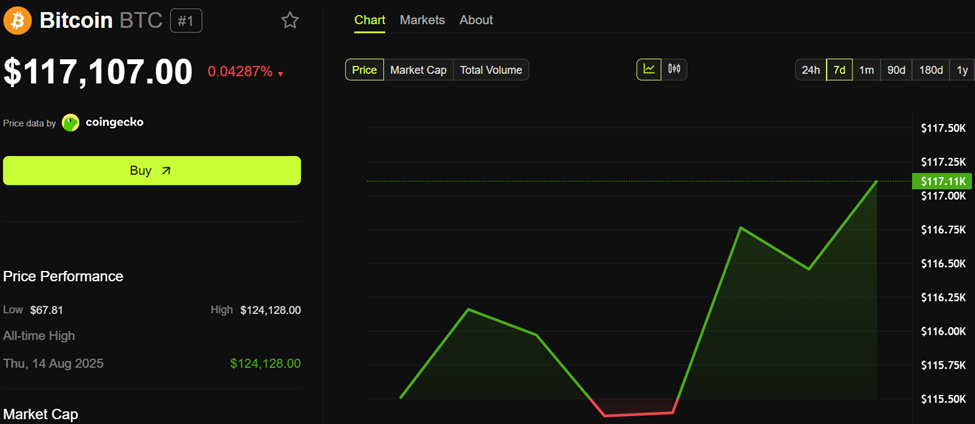
At the time of this writing, Bitcoin was trading at $117,107, while Ethereum traded hands for $4,572. Both assets showed strength following the Fed’s decision.
Nevertheless, there is a lot of risk and continues to invade investor trust. These include:
The labor market is softened by the recession, the stickiness of tariff-driven inflation, and the political overtones around Powell’s “risk management” framing.
If the Fed is cut too aggressively, there is a risk that it will lose credibility to combat inflation. At the same time, rising unemployment rates, if moved too carefully, can force more dramatic behavior later on.
Therefore, the next few weeks of risky assets like Bitcoin may be defined by liquidity-driven optimism. But this understands that this gathering rests on fragile ground.
It is worth noting that Powell himself acknowledged that the Fed is navigating a “challenging situation” where both sides of its mission shine red. The history of such moments shows that markets often gather first and consider later.
